The list is empty

Av Ida Simon-Andersson, HR/Marketing Manager at Nordic Pack AB
The choice of packaging is one of the last decisions in product development — and one of the most important. It determines whether the product meets shelf life, storage requirements and food approval. Glass jars are widely used in the food, dietary supplement, pharmaceutical and chemical-technical industries, but what separates a profitable packaging solution from an expensive re-design is whether you have asked the right questions from the start. If you have already decided on glass, you are in the right place to figure out the size and closure. Are you wondering instead whether glass or plastic is the right choice of material for your product, it's a good starting point. This guide will give you the decision-making information you need.
Glass jars are selected based on four factors: the chemical properties of the product, shelf-life requirements, the type of closure required for production, and your volume structure in the logistics chain. The size of the glass jar, glass color, and nozzle diameter affect everything from filling speed to pallet optimization, labeling area, and which filling machine you actually need to invest in.
Glass is the only common packaging material that is completely inert. It does not react with acids, fats, alcohol or aromas. For products with long shelf lives, sensitive taste profiles or strict regulatory requirements — food, herbal medicines, essential oils, spices and preserves — the glass jar is difficult to replace. The contents of a glass jar are not chemically altered by the wall of the packaging, which is the fundamental reason why foods with a 24–36 month shelf life are packaged in glass as standard.
For example, Swedish jam and marmalade producers who sell through the grocery store almost always choose glass jars with twist-off lids, as the combination provides a vacuum seal, a visible originality indicator and a shelf life exceeding 18 months without preservatives.
Volume determines more than storage space — it controls dosage, labeling space, pallet optimization and consumer behavior. B2B glass jars are typically delivered in the volume range of 30 ml to 5,000 ml, but the practically relevant segments are clear per industry.
For dietary supplements, 60–250 ml are the standard volumes. A 100 ml glass jar with a wide neck (63–82 mm nozzle) holds 90–120 capsules depending on capsule size and is DIN standard compatible with the most common filling machines in Sweden and the Nordic countries. Narrower necks, under 43 mm, are used for powders and granules to be dosed via spoon — wider necks provide easier filling but poorer dosing flow.
For food products — jams, marmalades, honey, preserves, pasta and sauces — volumes of 200–500 ml dominate in the grocery trade. The restaurant and horeca segment often orders 720 ml to 1,500 ml, combined with TO-82 or TO-63 lids that provide vacuum indication. A vacuum lid clicks in when the product cools after filling at 85–95°C. The click when the lid is opened confirms that the vacuum has held and that the package has not been broken since filling.
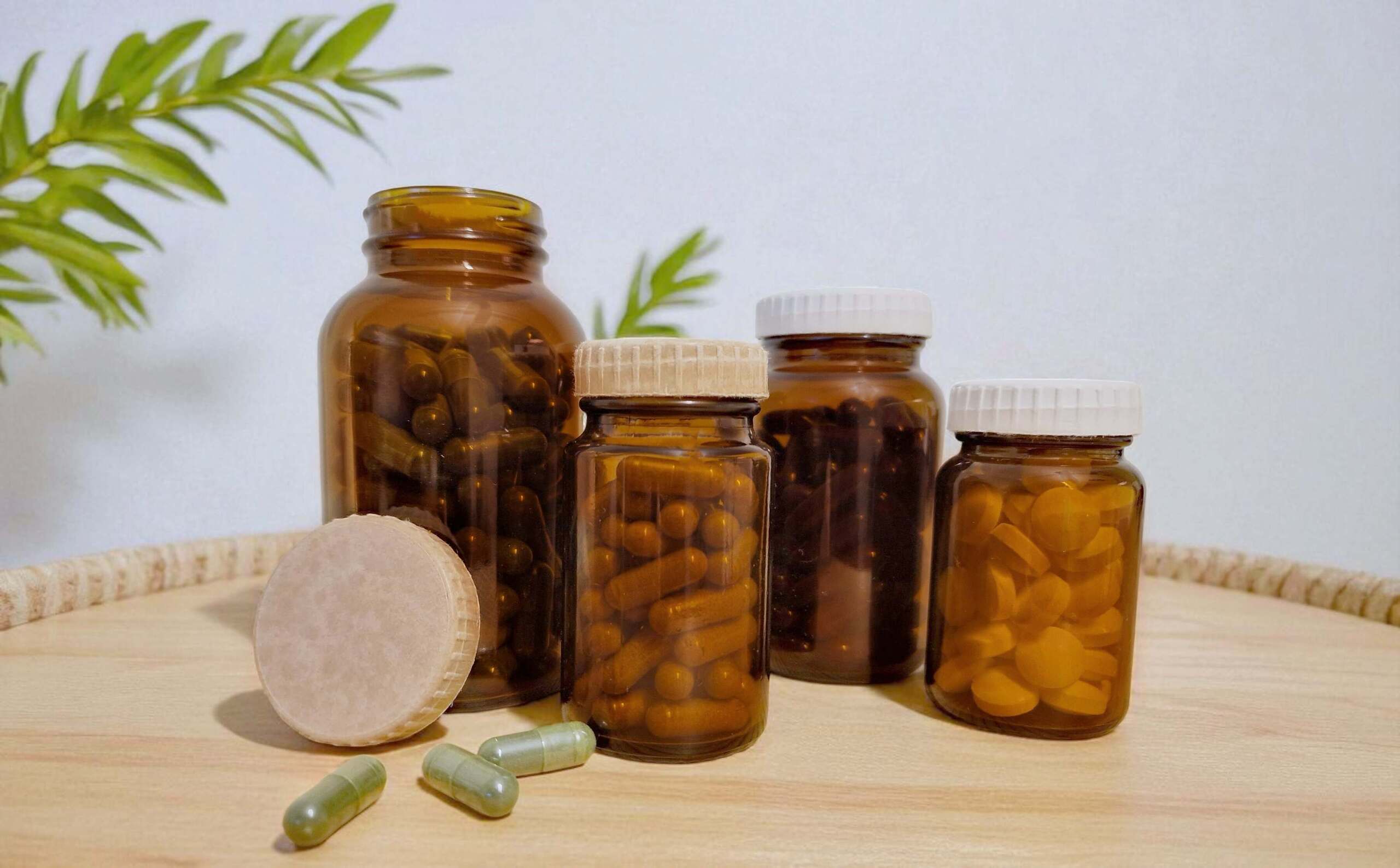
Life science, pharma and reagent applications use borosilicate or amber glass jars, typically 30–200 ml. Borosilicate withstands thermal shock better than standard glass and is used when the product is to be autoclaved. Amber glass absorbs UV radiation below 450 nm and protects light-sensitive substances — vitamins, omega-3 oils and phytochemicals degrade more quickly in clear glass.
The chemical-technical industry orders glass jars in 500 ml–5,000 ml sizes with chemical-resistant PP lids or PTFE-sealed aluminum lids. Glass's inertness to acids, alkalis and solvents makes it the first choice for laboratories and chemical processes where metal corrosion or plastic migration is unacceptable.
Concrete example: a food company producing chili jam for the Nordic market typically orders 1,500–2,000 units per run in 200 ml TO-63 glass jars — a volume range that optimizes the filling cost per unit without tying up capital in excess inventory.
The lid of a glass jar is a technical decision, not an aesthetic one. The wrong closure can cause leakage in transit, missed vacuum during pasteurization, or a filling machine configuration that does not match the jar nozzle. The three most common systems in a B2B context are twist-off, press-on, and screw-on — the same principles apply to glass bottles in beverage production and plastic bottles for B2B, if you also handle liquid products in your business.
Twist-off-lock (TO-lock) is the standard for hot-filled products — jams, sauces, honey, pickles. The lid is pressed while hot and a vacuum is created when the product cools. TO-63 and TO-82 are the most common sizes in the grocery trade. The vacuum indicator is built into the lid design, but the lid requires the correct filling temperature — filling too cold results in insufficient vacuum and shorter shelf life.
Press-on/twist-off (PT-lock) is used when hot filling is not appropriate — for example, for products where high temperatures negatively affect taste or texture. The lock is screwed on and the seal is in a plastic insert rather than in a vacuum. PT-lock is more common for cold chain and fresh produce than for traditional pickle production, which in many cases still uses hot filling with TO-lock.
Screw caps with liners are primarily used in the food supplement, pharmaceutical and chemical-technical industries. The liner material varies — PE-foam for dry products, Induction heat seal (IHS) for products that require a seal guarantee when opened. Induction seal requires an additional machine in the production line but is standard for food supplements in the grocery trade, as it meets EU requirements for originality protection.
Important to consider: the nozzle diameter (DIN size) must match your filling machine. If you change the glass jar without checking the DIN size, you risk a reconfiguration cost. A line adaptation for DIN 82 to DIN 63 can cost a larger amount for a simple production line. Always check that the new glass jar is DIN compatible with the existing filling.
Glass jars used for food or dietary supplements in Sweden and the EU are subject to the EU Framework Regulation on Contact Materials, (EC) No 1935/2004 (Finnish Food Authority, 2024). The basic requirement is that the material must not migrate substances into the food in quantities that could harm health or affect taste and smell.
Glass is inert and has no migration risks to food. What requires documentation is the lids — lids with plastic components in contact with food are covered by (EU) No 10/2011Your supplier should be able to deliver a Declaration of Compliance (DoC) confirming that the material meets applicable requirements for your specific product type.
Without a valid DoC, you cannot sell in the EU. In the event of a Swedish Food Agency inspection or trading partner requirement, the DoC is one of the first documents requested. Always check that the DoC specifically covers your product type — a DoC for pickles does not automatically apply to a high-fat pesto.
If you are unsure which regulatory authority applies to your business, your municipal environmental administration is usually the starting point.
Glass jars have the highest recycling rate of common packaging materials in Sweden. Glass reached a 98% recycling rate in 2024, compared to 31% for plastic packaging (Swedish Environmental Protection Agency, 2024). Glass can be recycled without loss of quality for an unlimited number of cycles, which distinguishes it from most plastic materials that deteriorate with repeated recycling (Recycling industries, 2024).
As a producer in Sweden, you fall under the Producer Responsibility Act if you put packaging material on the market. Glass jars give you a material with high recycling value and clear environmental performance to communicate to consumers and trading partners. The EU's Packaging Regulation (PPWR) is gradually tightening the requirements for packaging producers — the recycling properties of glass give you a strong position in that reregulation.
For example, Swedish honey producers and specialty food brands consistently choose glass jars over plastic packaging when they enter premium segments or export markets — partly for regulatory reasons, and partly because glass's sustainability profile is easier to communicate to end customers.
B2B orders for glass jars are almost always made against a quote rather than a fixed price list. The price per unit drops significantly for orders of 500+ units and drops further for pallet quantities, typically 1,000–5,000 units depending on jar size. The parameters that determine the price are volume, material thickness, glass color, lid type and any special label or embossing.
Delivery time is a factor to consider from day one. Standard clear glass jars and TO lids are often in stock at well-stocked wholesalers in Sweden and can be delivered within 1–5 working days. Special orders — for example amber glass jars, special volumes or label customization — require significantly longer lead times from the factory, often in Europe (Czech Republic, Poland, Austria).
Nordic Pack is a one-stop supplier for glass jars and other B2B packaging. This means you can consolidate glass jars, lids, labels and logistics with one provider — reducing administrative burden and providing better coordination when you need to adjust packaging choices for a product launch or reformulation.
TO-locks are used for hot-filled products and create a vacuum when the product cools down — the lid clicks down as a hygiene indicator. Screw caps with liners are suitable for cold fillings and dietary supplements, where PE-foam or aluminum foil provide sealing and originality protection. The choice is determined by the filling temperature.
The DIN size is given in millimeters for the can opening — most commonly DIN 43, DIN 63 and DIN 82 for food glass cans. Check your filling machine specification. Incorrect DIN size may require a reconfiguration that will cost a significant amount. Confirm DIN compatibility with the supplier before ordering.
Glass normally does not require DoC as it is inert, but lids with plastic components do, according to (EU) No 10/2011Always ask the supplier for the DoC and check that it specifically covers your product type — a generic DoC does not always cover all foods or product categories.
Packaging selection should be based on product requirements, closure system and regulatory documentation. Price is one factor among many. Take three things away from this guide: that the DIN dimension must match the filling machine before ordering, that caps with plastic components always require DoC, and that the supplier should be able to handle the glass jar, cap and logistics all together.
Would you like advice on which glass jar is right for your product? Contact Nordic Pack — we help you with decision-making, quotations and delivery for anything from 500 to 50,000 units.
We use AI as a tool for research and structure. All content is reviewed, fact-checked and rewritten by Ida Simon-Andersson at Nordic Pack AB — who is responsible for every word published.
Now your quotation request is sent to us and one of our sales representatives will process it and get back to you.
Thank you for showing interest in our products!
Questions about packaging solutions? Do you want inspiration and help from our packaging experts? We are happy to answer questions about packaging in general, and we can also offer more products than the ones you see on the website!
Leave your information and write your question in the form. We normally respond within 24 hours.