The list is empty

Av Ida Simon-Andersson, HR/Marketing Manager at Nordic Pack AB
Should honey jars be delivered in glass or plastic? The question arises every time a honey producer or retailer orders new packaging — and the answer affects shelf condition, transportation costs, and how the consumer perceives the product in the store.
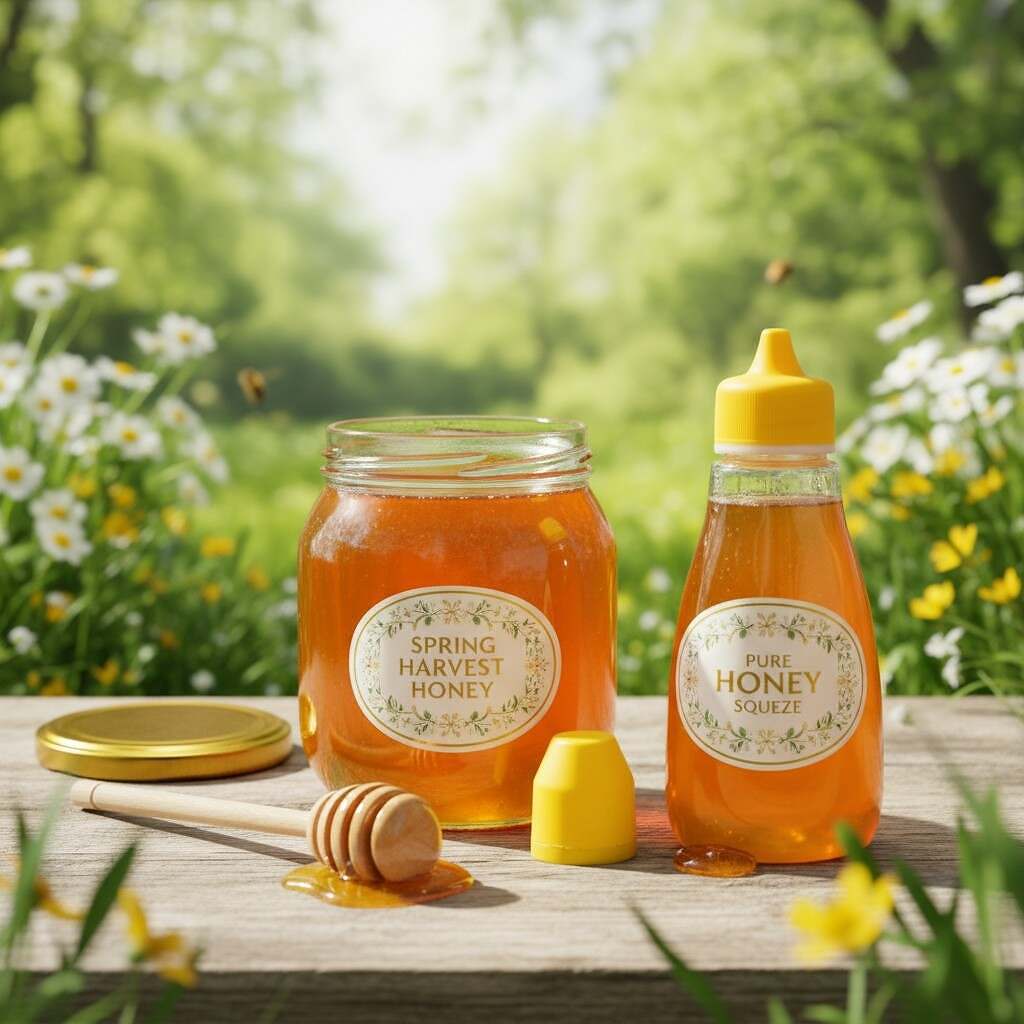
Glass honey jars provide longer shelf life, better flavor retention and a premium feel that attracts buyers in stores. Plastic jars are lighter, cheaper to transport and more impact-resistant, making them common for large consumers, bucket sizes and bulk deliveries to restaurants and wholesalers throughout the Nordic region.
The most common sizes for shelf sales are between 0,35 and 0,7 kg. Commercial formats often start at several kg per package — for example, 25 kg buckets are common for catering and bakery.
The choice is rarely about which material is "best" overall — it's about which material fits your specific combination of production volume, distribution channel, and customer segment. A small artisan producer selling to a farm shop has different requirements than a wholesaler supplying to grocery stores across the country.
Glass is chemically neutral and does not react with the honey, which means that the taste, aroma and nutritional content are preserved longer than in plastic. Glass jars are also transparent in a way that highlights the natural color of the honey — a property that is often actively used in store displays and gift packaging. Glass is also 98 percent recycled in Sweden, making it the most circular packaging material for honey.
All packaging must be approved for food contact, regardless of the material. This can be shown in several ways: with the glass/fork symbol, with the text "for food contact", or by clearly marking the packaging according to its intended use - a specific product name such as "honey jar" is normally considered sufficient identification (Finnish Food Authority, 2026). The crucial thing is that the supplier can show a declaration of conformity for the material — this applies to both glass and plastic.
In practice, this means that the purchasing decision is never just about appearance. For example, a producer who sells directly to grocery stores should always ask their packaging supplier for documentation on food approval before launching a new range. This should be done before the first delivery is already on the store shelf. The same requirements apply to all packaging types. If you want to read more about how to choose the right size and closure for glass jars in general, there is an in-depth guide to glass jars for B2B which goes through the same principles in more detail.
Plastic jars weigh a fraction of glass, which lowers shipping costs and reduces the risk of damage in transit. For large consumers, catering operations and restaurants that handle large volumes, this is often crucial. A cracked glass jar in a pallet creates both cost and waste, while a plastic jar withstands uneven handling much better. Plastic packaging is currently recycled at only 31 percent in Sweden, which is a factor that weighs into the sustainability calculation despite the lower transport emissions.
The disadvantage is that some plastics can slightly affect the aroma of the honey over time. Plastic also generally has a worse reputation among environmentally conscious consumers compared to glass, but for a correctly selected, food-approved plastic, the difference is often small in practice. A standard bucket size for commercial kitchens weighs around 25 kg when filled, which makes the choice of material extra important for handling and the working environment. For a complete overview of what is actually required for a package to be considered food-approved in Sweden, see our guide to requirements for food-approved packaging.
Recyclability is often the deciding factor, especially for brands that want to communicate a sustainability message. Here, there is a clear difference between the materials in practice: glass packaging in Sweden reached a material recycling rate of 98 percent in 2024 (Swedish Environmental Protection Agency, 2025). Plastic packaging reached only 31 percent in material recycling in the same year. Glass is recycled in a closed cycle that can be repeated in principle indefinitely, while plastic is more often downcycled into lower quality products.
At the same time, the overall climate impact is not always in glass's favor. Glass is heavier to transport, which increases emissions per unit delivered compared to lighter plastic packaging over the same distance. For longer transport distances, a lightweight plastic can can therefore have a lower overall climate footprint, despite the lower recycling rate. The important thing is to look at the entire chain — production, transport and final processing — instead of just looking at the recycling rate itself.
For producers who want to be able to answer sustainability questions from retailers or consumers in a concrete way, it is therefore worth asking their packaging supplier for information on the entire life cycle, not just the recyclability of the material. A supplier who can report both transport weight and recycling rate provides a more complete basis for a sustainable purchasing decision than just a comparison between materials. Do you want to understand more about how the recycling process for plastic and glass actually works in Sweden? We describe it step by step in a separate review of the recycling process for plastic and glass.
As a full-service supplier, we help customers see packaging and logistics as a cohesive business rather than two separate decisions. For example, we have helped customers calculate the total environmental and cost picture of an entire supply chain — not just the price per jar. This has been done before they changed materials in their honey range.
The size is primarily determined by who buys the product. For a long time, a 700 gram (0,7 kg) jar was the most common size on the Swedish market. Today, 500 gram (0,5 kg) and 350 gram (0,35 kg) are increasingly common for shelf sales, as households have become smaller. Larger jars and plastic buckets are still in demand by large consumers, bakeries and restaurants that bottle or use honey as an ingredient.
The closure plays almost as important a role as the material. An airtight seal protects the honey from moisture and prevents fermentation, while a loose seal can lead to crystallization or flavor changes even before the jar reaches the store shelf. For example, a producer planning gift packaging for a tourist market or Christmas sale should choose smaller sizes with extra secure seals, as these jars are often handled and transported more than the standard range.
A typical scenario is a medium-sized honey producer looking to expand their range from a single standard size to multiple formats — for example, a smaller gift jar for retail sales and a larger bucket size for restaurant customers. In such cases, it is common to combine glass for the consumer level and plastic for the catering level, rather than locking the entire range into one material.
The price of honey jars is primarily determined by material, volume and delivery method — not just by the unit price in a price list. Glass jars generally have a higher unit price than plastic. However, the difference is often evened out when the entire supply chain is taken into account: lower shipping costs for plastic can be partly eaten up by higher losses due to transport damage, while glass's longer shelf life can reduce scrapping at the store level.
The most common questions we receive from honey producers are about price, delivery terms, delivery time and minimum order quantity (MOQ). It is entirely reasonable to compare suppliers on all four points at the same time. A low unit price with a long delivery time or a high MOQ is rarely advantageous for a small or medium-sized producer who needs flexibility in their order planning.
Repackaging in stock is a concrete example of how delivery terms can make a bigger difference than the price of the material itself. A supplier who can repack smaller quantities from a larger pallet gives a producer the opportunity to test a new format or size. This can then be done without tying up capital in an entire pallet before demand is confirmed. This is especially valuable for producers who sell seasonally, for example ahead of the harvest in August-September or the Christmas shopping season.
Delivery time is also affected by whether the cans are delivered directly from the factory or from a Swedish warehouse. Factory delivery normally takes 6–8 weeks. Warehouse delivery, on the other hand, can often be made within 1–2 weeks. Warehouse delivery normally means shorter lead time but a slightly higher price per unit, while factory delivery can give a lower price for larger volumes but requires a longer planning horizon. Which option is worthwhile depends on how predictable your sales are over the year.
A hobby beekeeper or small farm producer often has completely different requirements than an industrial honey packer. For small-scale production, the choice is rarely about enormous volumes. Rather, it is about finding a format that looks professional on the shelf, can be labeled easily and does not require investment in special equipment for bottling. Here, jars in standard sizes such as 0,35 or 0,5 kg are often the easiest choice, as there are already ready-made lids and labels adapted for these formats on the market.
Large-scale producers and packaging wholesalers have another challenge: maintaining consistent quality and delivery reliability over large volumes, while keeping the cost per unit down. Volumes of several thousand cans per production run are not uncommon for the largest wholesalers. A production line that is dimensioned for 0,7 kg format rarely handles 0,35 kg cans without conversion. Here, issues such as pallet efficiency, automated bottling and compatibility with existing production lines become at least as important as the choice of material itself. A can that looks identical on the shelf may still be unsuitable for a particular production line if, for example, the neck diameter or the can's stability under the conveyor belt does not match the equipment.
A common mistake is to base the packaging solely on the consumer’s experience and ignore how it works in your own production. A can that is perfect for the store shelf can actually slow down a bottling line significantly if it is not dimensioned for the existing equipment. Before choosing a new format, it is therefore worth testing a small sample delivery in the actual production environment, not just judging the can based on appearance and price.
Glass provides the best flavor retention and premium feel, while plastic is cheaper and more durable in transportation. The choice depends on whether the jar will be on a store shelf or handled in large volumes by commercial kitchens and restaurants.
For shelf sales to consumers, 350–500 grams is most common in Sweden today. Larger packages of 700 grams and up are better suited for large consumers, gift assortments or specialized niche stores with higher average purchases.
Yes, provided the plastic is approved for food contact. Always ask the supplier for a declaration of conformity before putting new plastic packaging into use — it is the document that actually confirms the approval, and the symbol on the can is not the decisive factor.
An airtight seal prevents moisture and fermentation during storage and transport. Leaky lids increase the risk of crystallization and taste changes, especially during extended periods on the store shelf or during temperature changes in storage.
Glass and plastic have different strengths as honey packaging, and there is no generally right answer. Glass wins in terms of flavor preservation, premium feel, and a 98 percent recycling rate. Plastic wins in terms of weight, transportation cost, and durability in heavily handled areas, even though material recycling stops at 31 percent. Always match the material and size of your honey jars to how the honey is actually sold and handled — from production to store shelf — and make sure the packaging is always food-grade.
Do you want to know which material suits your business best? Contact Nordic Pack for advice on honey jars, sizes and closures that match your production — we help you see the whole chain, not just the price per jar. You can also go directly to our assortment of honey jars to see current formats and materials.
We use AI as a tool for research and structure. All content is reviewed, fact-checked and rewritten by Ida Simon-Andersson at Nordic Pack AB — who is responsible for every word published.
Now your quotation request is sent to us and one of our sales representatives will process it and get back to you.
Thank you for showing interest in our products!
Questions about packaging solutions? Do you want inspiration and help from our packaging experts? We are happy to answer questions about packaging in general, and we can also offer more products than the ones you see on the website!
Leave your information and write your question in the form. We normally respond within 24 hours.